Share
Share

Written by Zachary Newland, Founding Partner. Last updated September 2, 2026.
Grand Jury Testimony: What Healthcare Providers Must Know Before Testifying
On This Page
- Why Grand Jury Testimony Carries Serious Federal Consequences
- What Grand Jury Testimony Is and How It Works
- Target, Subject, or Witness: Your Classification Matters
- How Grand Jury Testimony Works in Healthcare Fraud Investigations
- Steps to Take Before You Testify
- How Evergreen Attorneys Can Help With Grand Jury Testimony
- Frequently Asked Questions
If you are a doctor, nurse, physician assistant, or other healthcare provider who has received a federal grand jury subpoena or learned that a grand jury is investigating your billing, referral, or prescribing practices, what you say under oath can determine whether you face federal criminal charges.
Put simply, when a physician is demanded to testify before a federal grand jury it is very different from other witnesses. There are specific rules governing patient confidentiality that apply for healthcare providers; physicians are often asked to give detailed explanations for specific medical treatments; physicians are often confronted with complex billing documents and asked to explain CPT codes. You need to be prepared by experienced federal criminal defense lawyers before walking into a healthcare fraud grand jury.
Grand jury testimony is compulsory, secret, and recorded. There is no judge in the room to sustain objections, and your attorney cannot sit beside you while you answer questions. Every answer you give can later be used to indict you, charge you with perjury, or lock in facts that prosecutors will exploit at trial.
If federal agents have contacted you or you have received a federal grand jury subpoena, contact Evergreen Attorneys at (303) 948-1489 before responding or producing information. We know our stuff when it comes to grand jury proceedings; read some of our other grand jury articles here:
- https://evergreenattorneys.com/federal-grand-jury/federal-grand-jury-subpoena/how-quickly-must-i-respond-to-a-grand-jury-subpoena/
- https://evergreenattorneys.com/federal-grand-jury/federal-grand-jury-subpoena-in-denver/
- https://evergreenattorneys.com/white-collar-crime/federal-grand-jury-subpoena/
Why Grand Jury Testimony Carries Serious Federal Consequences
Federal grand juries operate under Fed. R. Crim. P. 6 and function as investigative bodies, not trial courts. Their purpose is to determine whether probable cause exists to return an indictment. For healthcare providers caught in a federal fraud investigation, that process often centers on billing records, coding decisions, patient referrals, and compliance protocols.
The stakes are very real. False or inaccurate testimony under oath can result in separate federal charges for perjury (18 U.S.C. § 1621) or making false statements (18 U.S.C. § 1001). Admissions about billing practices, kickback arrangements, or documentation shortcuts can provide the evidentiary foundation for healthcare fraud, Anti-Kickback Statute, or False Claims Act charges carrying years of imprisonment and millions of dollars in fines.
What Grand Jury Testimony Is and How It Works
Grand jury testimony is sworn, recorded testimony given by a witness inside a closed grand jury proceeding. Unlike a trial, grand jury proceedings are one-sided: the prosecutor presents evidence and questions witnesses, and there is no defense attorney cross-examining or objecting.
Under DOJ Justice Manual section 9-11.000 on federal grand juries, the government controls the presentation of evidence. Witnesses are compelled to appear through a subpoena ad testificandum issued under Fed. R. Crim. P. 17. Once you are sworn in, you must answer each question unless you invoke a recognized privilege, most commonly the Fifth Amendment privilege against self-incrimination.
Your attorney may wait outside the grand jury room, and you may leave to consult with counsel before answering a question. But this right is procedural, not automatic; you must know to assert it, and repeated consultations can draw attention from the prosecutors and grand jurors.
Target, Subject, or Witness: Your Classification Matters
The DOJ Justice Manual classifies people involved in a grand jury investigation into three categories. Your classification directly affects the risks you face when testifying.
- Target: A person the prosecutor has substantial evidence to link to a federal crime and who the grand jury is likely considering for indictment. Targets who choose to testify must waive their Fifth Amendment privilege on the record.
- Subject: A person whose conduct falls within the scope of the investigation. Subjects may or may not become targets depending on the evidence, including their own testimony.
- Witness: A person who has relevant information but is not currently considered a target or subject. Witnesses can still become subjects or targets based on what they say.
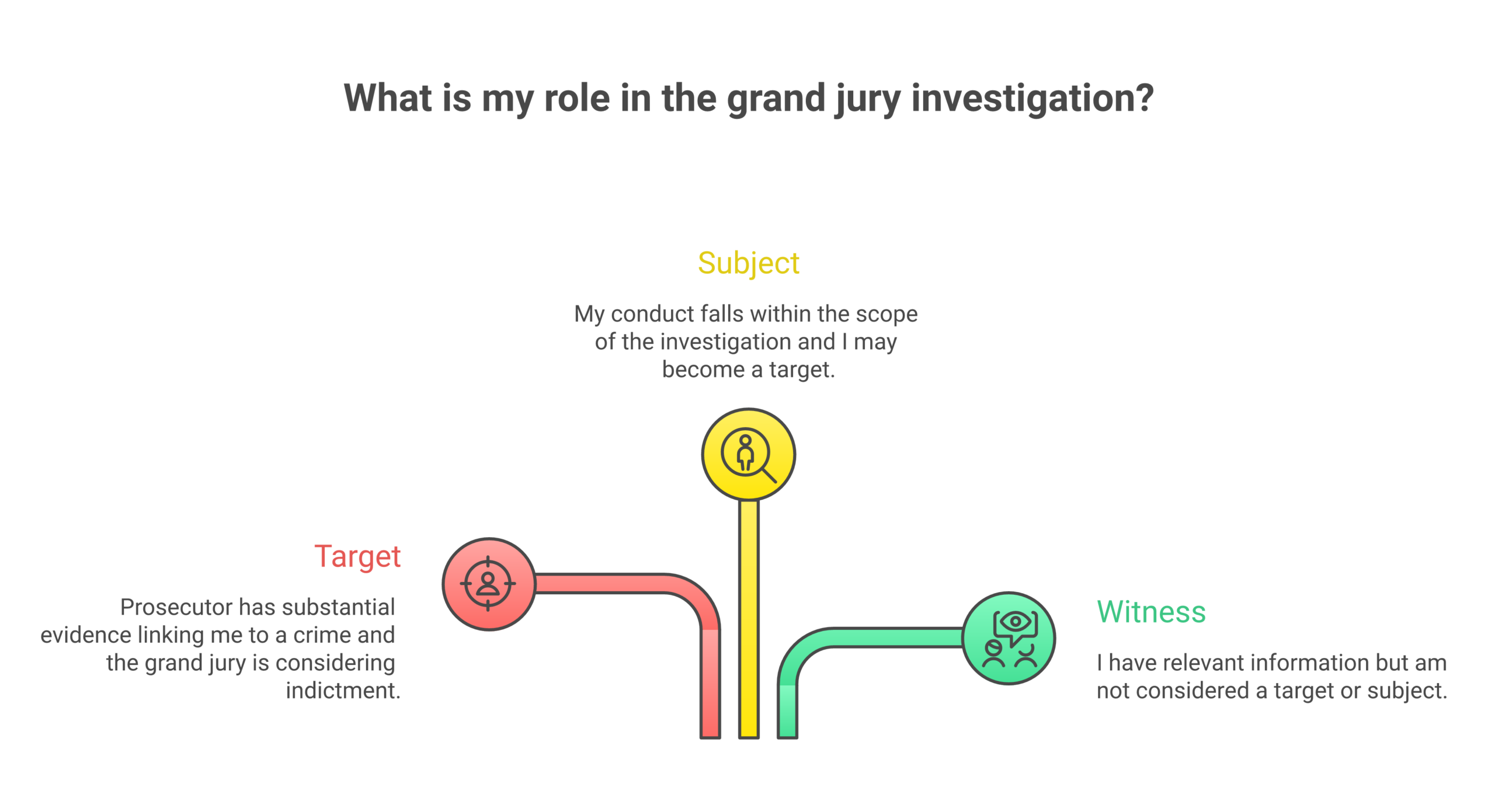
target, witness, subject grand jury
For healthcare providers, the distinction is critical. A physician subpoenaed as a “witness” about a colleague’s billing may discover during preparation that her own coding practices are under scrutiny. Understanding which category you fall into before you testify allows your attorney to evaluate whether asserting the Fifth Amendment, negotiating immunity, or requesting a postponement is the right course of action.
If you have received a federal target letter, your classification is already clear, and testifying without counsel’s guidance can be devastating.
Evergreen Attorneys won 9-0 in the U.S. Supreme Court in United States v. Hemani in June 2026, reflecting the elite caliber of federal defense work the firm brings to high-stakes matters including grand jury investigations.
How Grand Jury Testimony Works in Healthcare Fraud Investigations
Healthcare fraud grand jury investigations often follow a pattern. The Department of Health and Human Services Office of Inspector General (HHS-OIG) or FBI identifies billing anomalies, a qui tam relator files a complaint, or the DEA or OIG issues a subpoena for records. Once a federal prosecutor opens a grand jury investigation, the next step is subpoenaing witnesses.
A healthcare fraud grand jury subpoena typically demands both documents and testimony. Prosecutors use the documents to frame their questions, comparing what a provider billed against medical records, referral agreements, and communications. Common lines of questioning include whether the provider personally performed the services billed, whether referral payments were made to other providers, and whether the provider’s documentation accurately reflected the care delivered.
In 2026, it is very common for healthcare fraud investigations to have subpoenaed thousands of documents before calling in grand jury witnesses. It is also increasingly common for prosecutors to use algorithms to try and identify physicians that the government thinks are “outliers” and improperly practicing medicine.
Because grand jury proceedings are secret under Fed. R. Crim. P. 6(e), you will not know what other witnesses have said or what documents the government has already obtained. This asymmetry gives prosecutors a significant advantage: they may already know the answers to the questions they ask you, and any inconsistency between your testimony and the documentary record can become the basis for additional charges.
Steps to Take Before You Testify at Healthcare Fraud Grand Jury
If you have received a grand jury subpoena or a civil investigative demand requiring your testimony, take these steps in order:
- Retain experienced federal defense counsel immediately. Do not wait until the day before your testimony. An attorney who handles federal healthcare fraud defense can assess your exposure, determine your DOJ classification, and build a preparation plan.
- Determine your status as a target, subject, or witness. Your attorney can contact the assigned Assistant U.S. Attorney to clarify your classification and request any target or subject letter the government may have issued.
- Gather and review relevant records. Compile billing records, medical charts, communications, and compliance documents that relate to the subpoena’s scope. Your attorney should review them before your testimony so your answers align with the documentary evidence.
- Conduct a thorough witness preparation session. Practice answering the types of questions prosecutors are likely to ask. Identify areas where the Fifth Amendment applies and rehearse the process of leaving the room to consult counsel.
- Decide whether to invoke the Fifth Amendment. If your testimony could incriminate you, your attorney can advise you to assert the privilege on a question-by-question basis. In some cases, your attorney may negotiate use immunity or transactional immunity with the prosecutor before you testify.
- Do not discuss your testimony with other witnesses. Grand jury secrecy rules under Fed. R. Crim. P. 6 prohibit disclosure of matters occurring before the grand jury by certain participants. Even where the rule does not technically bind you as a witness, discussing your testimony with co-workers or other providers can create allegations of obstruction or witness tampering.
How Evergreen Attorneys Can Help With Grand Jury Testimony
Evergreen Attorneys represents healthcare providers, physicians, and practice owners facing federal grand jury investigations, including healthcare fraud matters involving Medicare and Medicaid billing, Anti-Kickback Statute allegations, and False Claims Act exposure. The firm’s federal defense attorneys handle pre-trial federal investigations. This means that Evergreen Attorneys work with sophisticated clients from the first time an investigation begins, well before a grand jury, all the way through trial.
Zachary Newland, Founding Partner, has appeared as counsel of record in more than 130 federal cases since 2016, including matters involving grand jury subpoenas, target letters, and federal healthcare fraud investigations.
The firm assesses each client’s criminal exposure, reviews the subpoena and underlying records, and prepares a detailed testimony strategy. When appropriate, Evergreen Attorneys negotiates with prosecutors about immunity, scope, and timing before the client enters the healthcare fraud grand jury room.
Frequently Asked Questions
What is the difference between a target, subject, and witness in a federal grand jury investigation?
The DOJ Justice Manual defines these classifications based on your proximity to potential charges. A target is someone the government believes it has substantial evidence against and is likely to indict. A subject is someone whose conduct is within the scope of the investigation but who has not yet been identified for likely indictment. A witness is someone with relevant information who is not currently considered a target or subject. Your classification determines your exposure level: targets who testify must waive their Fifth Amendment rights on the record, while witnesses retain broader options for asserting privileges.
Can I bring my attorney into the grand jury room when I testify?
No. Under federal rules, your attorney cannot be present inside the grand jury room during your testimony. However, you have the right to leave the room to consult with your attorney before answering any question. This makes thorough preparation before your appearance essential, because you need to know in advance which questions require consultation and which areas implicate the Fifth Amendment. Your attorney will typically wait immediately outside the grand jury room so consultations can happen quickly.
What happens if I give inaccurate testimony before a federal grand jury?
Inaccurate grand jury testimony can result in federal perjury charges under 18 U.S.C. § 1621 or false statement charges under 18 U.S.C. § 1001, each carrying penalties of up to five years of imprisonment. For healthcare providers, inaccurate statements about billing practices, patient records, or compliance measures can also be used as evidence of intent to defraud in the underlying healthcare fraud case. Prosecutors routinely compare grand jury transcripts against documentary evidence, and inconsistencies become powerful tools for the government at trial.
When should a physician involve federal defense counsel after receiving a grand jury subpoena?
You should retain federal defense counsel as soon as you receive the subpoena or learn that a grand jury is investigating matters connected to your practice. The period between receiving a subpoena and testifying is when the most important strategic decisions are made: determining your classification, reviewing records for accuracy, identifying privilege issues, and potentially negotiating with prosecutors. Waiting until shortly before your scheduled appearance limits your attorney’s ability to protect you and may force you to testify without adequate preparation, increasing the risk of self-incrimination or perjury exposure.
If you are facing a federal grand jury subpoena or have been called to testify in a healthcare fraud investigation, contact Evergreen Attorneys at (303) 948-1489 for a confidential case evaluation today.

Zachary Newland
Zachary Newland is an attorney, author, aspiring BBQ connoisseur, and enthusiastic, but mediocre skier. Zachary's law practice is focused on federal criminal defense, federal appellate advocacy including post-conviction remedies, civil rights litigation, and complex trial work. Zachary lives in Evergreen, Colorado with his family. Reach out today
STAY IN THE LOOP