Share
Share

Written by Zachary Newland, Founding Partner. Last updated August 29, 2026.
Aggravated Identity Theft and Healthcare Fraud: The Charge That Adds Mandatory Prison Time to Fraud Cases
On This Page
- What Is Aggravated Identity Theft?
- How 18 U.S.C. § 1028A Works
- Aggravated Identity Theft in Healthcare Fraud Prosecutions
- The Knowledge Requirement: What the Government Must Prove
- What to Do If You Are Facing an Aggravated Identity Theft Charge
- How Evergreen Attorneys Can Help
- Frequently Asked Questions
An aggravated identity theft charge under federal law carries a mandatory two-year prison sentence that runs on top of the punishment for any other charged crime.
For anyone charged with healthcare fraud, wire fraud, or another federal felony, this add-on charge can dramatically increase total prison exposure with no possibility of a downward departure. If you are under federal investigation or have already been charged, contact Evergreen Attorneys at (303) 948-1489 before responding to investigators or producing any information.
The Colorado healthcare fraud defense team at Evergreen Attorneys is ready and willing to protect your freedom and reputation.
What Is Aggravated Identity Theft?
Aggravated identity theft is a federal offense defined by 18 U.S.C. § 1028A. The statute targets conduct that goes beyond ordinary identity fraud: it applies when a person knowingly transfers, possesses, or uses the means of identification of another person, without lawful authority, during and in relation to a qualifying federal felony.
The statute was enacted as part of the Identity Theft Penalty Enhancement Act of 2004. Congress designed it to stack a fixed prison term on top of the sentence for the predicate crime. It is not a standalone charge; the government must tie it to one of dozens of enumerated federal fraud crimes listed in the statute.
How 18 U.S.C. § 1028A (Aggravated Identity Theft) Works
The mechanics of this federal identity theft sentencing enhancement are straightforward but unforgiving.
Elements the Government Must Prove
To secure a conviction, federal prosecutors must establish each of these elements beyond a reasonable doubt:
- The defendant knowingly transferred, possessed, or used a means of identification.
- That means of identification belonged to another actual person.
- The defendant did so without lawful authority.
- The conduct occurred “during and in relation to” a qualifying federal felony listed in the statute.
Aggravated Identity Theft Mandatory Minimum
Consecutive Sentencing: Why the Penalty Is Different
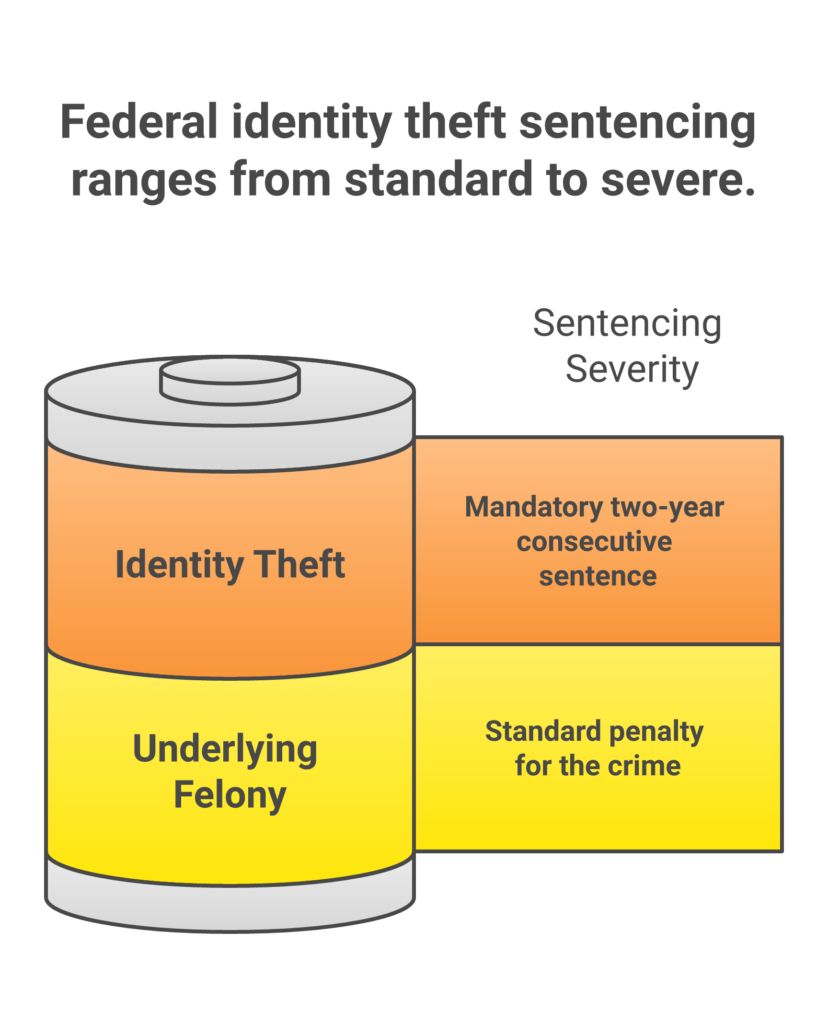
The standard penalty under § 1028A is a mandatory minimum of two years in federal prison. What makes this charge particularly severe is the consecutive sentencing requirement: the two-year term must be added after the sentence for the underlying felony. A federal judge has no discretion to run it concurrently or to depart below the mandatory floor.
According to the United States Sentencing Commission aggravated identity theft quick facts, this mandatory 24-month sentence applies regardless of the defendant’s criminal history category or other mitigating circumstances.
Predicate Offenses
Section 1028A lists dozens of qualifying federal felonies. The most commonly charged predicates include:
- Wire fraud (18 U.S.C. § 1343)
- Mail fraud (18 U.S.C. § 1341)
- Healthcare fraud (18 U.S.C. § 1347)
- Bank fraud (18 U.S.C. § 1344)
- False Claims Act internal investigations and related fraud offenses
- Immigration document fraud
Evergreen Attorneys wins 9-0 in the U.S. Supreme Court.
Aggravated Identity Theft in Healthcare Fraud Prosecutions
Federal prosecutors routinely add aggravated identity theft counts in health care fraud defense cases. The charging theory is often simpler than defendants expect: if the government alleges that a provider used a patient’s name, Medicare beneficiary number, or other identifying information in connection with a fraudulent billing scheme, that use can support a § 1028A count.
This means that conduct ordinarily viewed as billing fraud, not identity theft in the colloquial sense, can trigger the mandatory two-year consecutive sentence. For example, a provider accused of submitting claims for services not rendered may face aggravated identity theft charges based on the patient identifiers included in those claims. A DME fraud federal investigation defense or federal healthcare fraud defense case can quickly escalate when prosecutors attach § 1028A counts.
The practical consequence is significant: each patient whose identifying information was allegedly used can support a separate aggravated identity theft count. In large healthcare fraud indictments, this can translate to years of additional mandatory prison time stacked on top of the base fraud sentence.
The Knowledge Requirement: What the Government Must Prove
One of the most important elements in an aggravated identity theft case is the identity theft knowledge requirement. The government must prove that the defendant knew the means of identification belonged to another actual, real person.
This requirement matters for several reasons:
- A fabricated Social Security number or a made-up name that does not belong to a real individual generally does not satisfy the statute.
- The government must connect the identifier to an actual person, not merely show that a false document was used.
- Courts and jury instructions treat this knowledge element as part of the prosecution’s burden of proof.
In healthcare fraud prosecutions, this element can become a contested factual issue. The defense may argue that the defendant did not know a particular identifier belonged to a real patient, or that the use of the identifier was authorized and within the scope of lawful medical practice.
What to Do If You Are Facing an Aggravated Identity Theft Charge
If you have been charged with aggravated identity theft or learned that federal investigators are examining conduct that could support such a charge, take these steps immediately:
- Stop speaking to federal agents, case agents, or investigators without counsel present. Anything you say can and will be used to establish the knowledge and intent elements of § 1028A.
- Retain a federal criminal defense attorney who understands consecutive sentencing for federal fraud and the specific elements the government must prove under § 1028A.
- Preserve all documents, communications, and records related to the alleged predicate offense. Do not destroy, alter, or move any evidence.
- Identify every count in the indictment or complaint that references § 1028A and determine which predicate offense each count is tied to.
- Assess the government’s evidence on the knowledge requirement for each count. The strength or weakness of the government’s proof that you knew the identifier belonged to a real person is often a central defense issue.
How Evergreen Attorneys Can Help
Evergreen Attorneys focuses exclusively on federal criminal defense. When a client faces aggravated identity theft charges, the firm analyzes whether the government can actually prove each element of 18 U.S.C. § 1028A, including the knowledge requirement and the necessary connection to a predicate felony.
In healthcare fraud cases, this analysis is particularly important because prosecutors often treat routine billing identifiers as grounds for stacking multiple § 1028A counts. Evergreen Attorneys examines the charging theory for weaknesses, evaluates whether the alleged use of identifying information was authorized, and builds a defense strategy around the evidence and the full scope of sentencing exposure.
Zachary Newland has appeared as counsel of record in more than 130 federal cases since 2016, and the firm handles federal fraud and healthcare fraud defense matters nationwide.
Frequently Asked Questions
What is aggravated identity theft under federal law?
Aggravated identity theft is a federal crime defined by 18 U.S.C. § 1028A. It applies when a person knowingly transfers, possesses, or uses the means of identification of another person, without lawful authority, during and in relation to a qualifying federal felony. The statute is frequently charged alongside fraud offenses, including healthcare fraud.
What is the mandatory minimum sentence for aggravated identity theft?
The blanket mandatory minimum is two years (24 months) in federal prison. That sentence must run consecutively to the punishment for the underlying predicate offense. A federal judge cannot reduce, suspend, or run this sentence concurrently with the base fraud sentence.
Can aggravated identity theft be charged in a healthcare fraud case?
Yes. Federal prosecutors routinely charge aggravated identity theft when the alleged healthcare fraud involved using a patient’s name, Medicare number, or other identifying information in connection with fraudulent billing, enrollment, or claims. The critical question is whether the identity use was knowingly tied to the underlying federal crime.
Does the government have to prove the identifier belonged to a real person?
Yes. In ordinary § 1028A aggravated identity theft prosecutions, the government must prove that the defendant knew the means of identification belonged to another actual person. The statute is not satisfied by the use of a fabricated or fictitious identifying information. Courts treat this knowledge element as an essential part of the government’s burden of proof.
When should someone facing federal fraud charges involve defense counsel regarding a potential § 1028A count?
Immediately. Because aggravated identity theft carries a mandatory consecutive sentence, the earlier defense counsel can evaluate the government’s evidence on each element, the more options remain for challenging the charge, negotiating the case, or preparing for trial. Waiting until after indictment narrows the available defense strategies and increases the risk of avoidable sentencing exposure.
If you are facing aggravated identity theft charges or a federal investigation involving healthcare fraud or another predicate offense, contact Evergreen Attorneys at (303) 948-1489 for a confidential case evaluation.

Zachary Newland
Zachary Newland is an attorney, author, aspiring BBQ connoisseur, and enthusiastic, but mediocre skier. Zachary's law practice is focused on federal criminal defense, federal appellate advocacy including post-conviction remedies, civil rights litigation, and complex trial work. Zachary lives in Evergreen, Colorado with his family. Reach out today
STAY IN THE LOOP
Subscribe to our free newsletter.

Written byZachary Newland, Founding Partner. [...]