Share
Share

Written by Zachary Newland, Founding Partner. Last updated August 28, 2026.
Federal Search Warrant at a Medical Practice: What Physicians Need to Know
On This Page
- Why a Federal Search Warrant at Your Practice Is a Serious Event
- What Is a Federal Search Warrant?
- How Rule 41 Controls Federal Search Warrants in Healthcare Fraud Cases
- What to Do When Federal Agents Execute a Search Warrant at Your Office
- Search Warrant vs. Subpoena: Why the Distinction Matters
- How Evergreen Attorneys Helps Physicians After a Federal Raid
- Frequently Asked Questions
Why a Federal Search Warrant at Your Practice Is a Serious Event
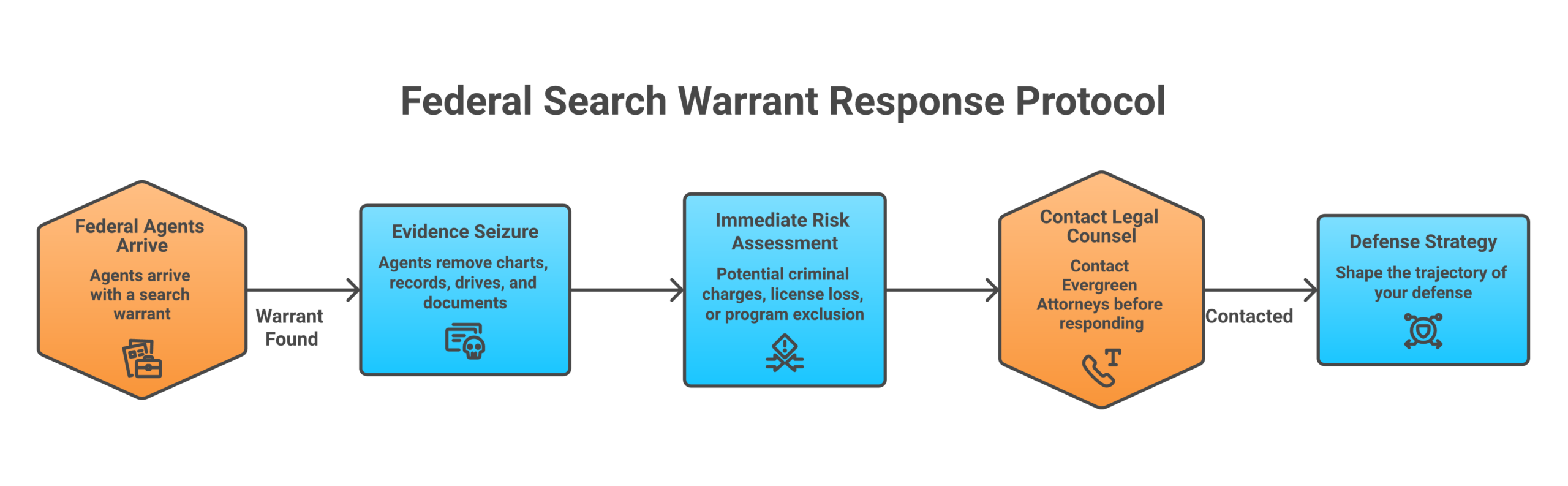
When federal agents arrive at a doctor’s office with a search warrant, the investigation behind that warrant is almost never new. A federal search warrant means that a U.S. magistrate judge has already found probable cause to believe evidence of a federal crime exists inside your practice. Agents from the FBI, HHS-OIG, DEA, or a joint task force may enter, remove patient charts, billing records, hard drives, and financial documents, and do so with legal authority you cannot override on the spot.
The stakes are immediate and severe. A raid can lead to criminal charges under statutes such as 18 U.S.C. § 1347 (Health Care Fraud), exposure to forfeiture proceedings, loss of medical licenses, and exclusion from Medicare and Medicaid programs. What you do and say during the first hour of a federal search warrant execution can shape the entire trajectory of your defense. If federal agents have contacted you or you have received a federal document, contact Evergreen Attorneys at (303) 948-1489 before responding or producing information.
What Is a Federal Search Warrant?
A federal search warrant is a court order issued by a U.S. magistrate judge under Rule 41 of the Federal Rules of Criminal Procedure that authorizes federal law enforcement to search a specific location and seize items described in the warrant. The warrant must be supported by an affidavit establishing probable cause, which means the government has presented facts and sworn testimony showing a fair probability that evidence of a federal crime will be found at the location.
In a healthcare fraud investigation, a search warrant typically targets a physician’s office, clinic, or billing center. Agents are authorized to remove the specific categories of items listed in the warrant’s attachments: patient records, billing data, correspondence, computers, servers, and financial documents linked to alleged fraudulent claims submitted to Medicare, Medicaid, TRICARE, or private insurers.
A search warrant is not a request. It is a judicial command. Once agents present a valid warrant, they have the legal authority to enter and search the described premises without your consent.
How Rule 41 Controls Federal Search Warrants in Healthcare Fraud Cases
The Fourth Amendment and Rule 41 impose specific requirements that every federal search warrant must satisfy. Understanding these requirements is critical because a failure to meet any of them may provide grounds for your attorney to challenge the warrant or seek suppression of evidence.
Probable cause. The government must demonstrate, through a sworn affidavit, that there is a fair probability that evidence of a specific federal crime will be found at the location. In healthcare fraud cases, the affidavit often relies on data analytics showing billing anomalies, whistleblower complaints, or information obtained through earlier grand jury subpoenas.
Particularity. The warrant must identify with specificity both the place to be searched and the items to be seized. A warrant that authorizes agents to seize “all records” without limitation may be vulnerable to a particularity challenge. In practice, healthcare fraud warrants include detailed attachments listing categories such as patient charts for specific date ranges, billing submissions to identified federal programs, and electronic data related to specified CPT or HCPCS codes.
Neutral magistrate. The warrant must be issued by a neutral and detached U.S. magistrate judge, not by a law enforcement agent or prosecutor.
Daytime execution. Rule 41 generally requires that warrants be executed during daytime hours unless the magistrate judge specifically authorizes nighttime execution based on a showing of necessity.
Scope limitations. Agents may search only the areas and seize only the items described in the warrant. If agents attempt to expand the search beyond what the warrant authorizes, your attorney can later move to suppress evidence obtained outside the warrant’s scope.
Colorado’s Supreme Court-proven Federal Criminal Defense Team.
What to Do When Federal Agents Execute a Search Warrant at Your Office
The first minutes of a federal raid at your medical practice are disorienting. Having a clear plan protects your rights and strengthens your defense. Follow these steps:
- Remain calm and do not physically resist. Federal agents executing a valid warrant have the legal authority to enter. Attempting to block entry, destroy documents, or conceal records can result in separate federal charges for obstruction of justice or evidence tampering.
- Ask to see the warrant and its attachments. Request a copy of the signed warrant and every attachment. Confirm that the warrant identifies your specific premises and review the list of items authorized for seizure.
- Contact federal criminal defense counsel immediately. Call an experienced federal criminal defense attorney before answering any questions. You have no obligation to speak with agents, and anything you say can be used against you.
- Instruct staff not to answer questions. Direct all employees, partners, and contractors present at the practice to decline interviews until counsel arrives. Staff members are not required to provide statements.
- Document the search. Record agent names, badge numbers, agency affiliations, and the time the search begins and ends. Note which rooms agents enter, which items they seize, and any statements agents make about the scope of the search.
- Do not consent to searches beyond the warrant’s scope. If agents ask to search areas or seize items not listed in the warrant, politely decline and state that you are limiting consent to what the warrant authorizes.
After the agents leave, preserve a copy of the warrant, the inventory receipt agents are required to provide, and your own notes. Provide all of this to your attorney promptly.
Search Warrant vs. Subpoena: Why the Distinction Matters
Physicians sometimes confuse a federal search warrant with a subpoena, but these are fundamentally different legal tools with different implications for your exposure.
A grand jury subpoena or a DEA administrative subpoena under 21 U.S.C. § 876 compels you to produce specified records by a future deadline. A subpoena gives you time to consult with counsel, negotiate the scope of production, and assert applicable privileges before producing anything. For guidance on responding to a DEA or administrative subpoena, see this overview of DEA or OIG subpoena compliance.
A search warrant, by contrast, authorizes agents to enter your premises and seize evidence immediately. There is no negotiation window. The warrant’s existence means a federal judge has already concluded that probable cause supports the search, and execution happens on the government’s timeline.
The distinction matters for assessing where you stand in an investigation. A subpoena may come early, when the government is still gathering information. A search warrant usually signals that the investigation has matured to the point where the government believes it already has probable cause that a federal crime has occurred. In DOJ and HHS-OIG healthcare fraud enforcement actions, the execution of search warrants at physician offices and clinics is a standard tool in cases involving allegations of healthcare fraud, kickback schemes, or DME fraud.
How Evergreen Attorneys Helps Physicians After a Federal Raid
Evergreen Attorneys focuses exclusively on federal criminal defense and represents physicians, healthcare executives, and medical practices facing federal search warrants and healthcare fraud investigations nationwide.
When a physician’s office has been raided, the firm’s attorneys review the warrant and supporting affidavit to determine whether the government satisfied Rule 41’s probable cause and particularity requirements. They assess whether agents exceeded the warrant’s scope during execution, identify any basis for a suppression motion, and evaluate the physician’s exposure under healthcare fraud statutes including 18 U.S.C. § 1347 and related theories such as Anti-Kickback Statute violations and False Claims Act liability with criminal implications.
The firm coordinates an immediate response strategy: preserving attorney-client privileged and work-product materials that agents may have seized, managing communications with staff and business partners, engaging with DOJ, HHS-OIG, or DEA agents through counsel, and preparing for grand jury proceedings or formal charges that frequently follow a raid.
For physicians already aware of an investigation before a warrant is executed, the firm also advises on what happens after a federal search warrant and how to position the defense for the next phase.
Frequently Asked Questions
Can federal agents search a physician’s office without a warrant?
In limited circumstances, yes. Federal agents may conduct a warrantless search if the physician or an authorized person with control over the premises voluntarily consents. Agents may also enter without a warrant under recognized exceptions such as exigent circumstances, where there is an immediate risk that evidence will be destroyed. However, the vast majority of federal healthcare fraud searches are conducted under a warrant issued by a U.S. magistrate judge. If agents arrive without a warrant and request access, you are not required to consent. Politely decline, state that you want to speak with your attorney, and document the encounter.
What are my rights when the DEA executes a search warrant at my clinic?
You have the right to see the warrant and its attachments, the right to remain silent, and the right to counsel. You are not required to answer agents’ questions, provide a statement, or assist in the search beyond what the warrant compels. You may observe the search to the extent agents permit it, and you should document which items are taken. You also have the right to insist that agents limit their search to the areas and items described in the warrant. If agents attempt to seize materials outside the warrant’s scope or conduct interviews of staff, instruct everyone to decline until your attorney is present.
What is the difference between a federal search warrant and a subpoena for medical records?
A federal search warrant authorizes agents to enter your premises immediately and seize specified evidence. A subpoena, whether a grand jury subpoena or a DEA administrative subpoena under 21 U.S.C. § 876, requires you to produce identified records by a future date. A subpoena allows time to consult counsel, negotiate scope, and raise privilege objections before producing documents. A search warrant does not. The critical implication: if the government has obtained a search warrant rather than issuing a subpoena, it typically means the investigation is further advanced and the government believes it already has probable cause to suspect a federal crime.
When should a physician or medical practice involve federal defense counsel?
The moment you learn that federal agents are executing a search warrant at your practice, you should contact federal criminal defense counsel. Ideally, you would retain counsel even earlier, at the first sign of a federal investigation: a grand jury subpoena, a civil investigative demand, unusual audit activity from Medicare or Medicaid contractors, or contact from an HHS-OIG or DEA agent. By the time a search warrant is executed, the government’s investigation is typically well advanced. The earlier counsel is involved, the more options exist to protect privileged materials, manage staff exposure, and shape the defense before charges are filed.
If you are facing a federal search warrant at your medical practice or a healthcare fraud investigation, contact Evergreen Attorneys at (303) 948-1489 for an immediate confidential case evaluation today.

Zachary Newland
Zachary Newland is an attorney, author, aspiring BBQ connoisseur, and enthusiastic, but mediocre skier. Zachary's law practice is focused on federal criminal defense, federal appellate advocacy including post-conviction remedies, civil rights litigation, and complex trial work. Zachary lives in Evergreen, Colorado with his family. Reach out today
STAY IN THE LOOP