Share
Share
Written by Zachary Newland, Founding Partner
Prediction Markets and Federal Criminal Exposure: What Traders and Platform Operators Need to Know
On This Page
- What Are Prediction Markets and Event Contracts?
- Federal Statutes and Rules That Apply to Prediction Markets
- How CFTC Investigations Work
- When a CFTC Matter Becomes a Criminal Case
- What to Do if You Face a Prediction-Market Investigation
- How Evergreen Attorneys Can Help
- Frequently Asked Questions
Prediction markets are drawing aggressive federal enforcement attention. In 2026, the Commodity Futures Trading Commission filed civil complaints alleging that traders used material nonpublic information to profit from event contracts on platforms like Polymarket, with the government claiming illicit gains exceeding $404,000 in one case and approximately $1.2 million in another. (Available here: https://www.cftc.gov/PressRoom/PressReleases/9217-26 ).
For any trader, platform operator, or business connected to prediction markets, these actions signal that the CFTC treats event-contract fraud and manipulation as a high-priority enforcement target, and that the conduct alleged in a civil case can also carry the risk of federal criminal prosecution under the Commodity Exchange Act.
If you are involved in prediction markets and need defense counsel for a federal investigation, reach out to Evergreen Attorneys today at (303) 948-1489. Kalshi and Polymarket related criminal investigations are on the rise in federal court.
What Are Prediction Markets and Event Contracts?
Prediction markets are exchanges where participants buy and sell contracts tied to the outcome of real-world events. According to the CFTC explanation of prediction markets and event contracts, these products are commonly called event contracts and are typically structured as swaps. They use binary outcomes, fixed payouts, and expiration tied to a specified event or date. The CFTC has regulated these instruments since 2004.
A person trading on whether a particular agency will take a specific action next month, or whether a public company will meet an earnings target by a given date, is trading an event contract; these can also apply to sports event as well.
The legal characterization of any particular contract depends on its structure, the platform on which it trades, and governing federal law. The critical point for traders and operators is that these contracts fall within the CFTC’s enforcement jurisdiction when they qualify as swaps or commodity transactions under the Commodity Exchange Act.
Federal Statutes and Rules That Apply to Prediction Markets
Several federal provisions create civil and criminal liability for misconduct involving event contracts:
- 7 U.S.C. § 9 (CEA § 6(c)(1)) prohibits the use of manipulative or deceptive devices in connection with swaps and covered commodity transactions. This is the CFTC’s primary anti-manipulation authority for event contracts.
- 17 C.F.R. § 180.1 is the CFTC’s anti-fraud and anti-manipulation regulation. It extends to misuse of material nonpublic information, false statements, and schemes to defraud in covered transactions.
- 7 U.S.C. § 6c prohibits fictitious sales, wash sales, false prices, and knowingly entering a swap as part of a scheme to defraud.
- 7 U.S.C. § 13 is the criminal enforcement provision of the Commodity Exchange Act. It provides felony penalties for specified manipulation and knowing violations of the Act.
The CFTC’s 2026 Advance Notice of Proposed Rulemaking on prediction markets confirms that the agency is actively considering additional regulatory requirements for event-contract derivatives, including statutory core principles and restrictions on contracts that may be contrary to the public interest. Available here: https://www.cftc.gov/PressRoom/PressReleases/9307-26
How CFTC Investigations Work
The CFTC’s Enforcement Division conducts investigations into suspected violations involving prediction markets and event contracts. The CFTC prediction-markets enforcement advisory describes the types of conduct the agency targets: misuse of nonpublic information, conflicts of interest, fraud, and other illegal trading practices on designated contract markets.
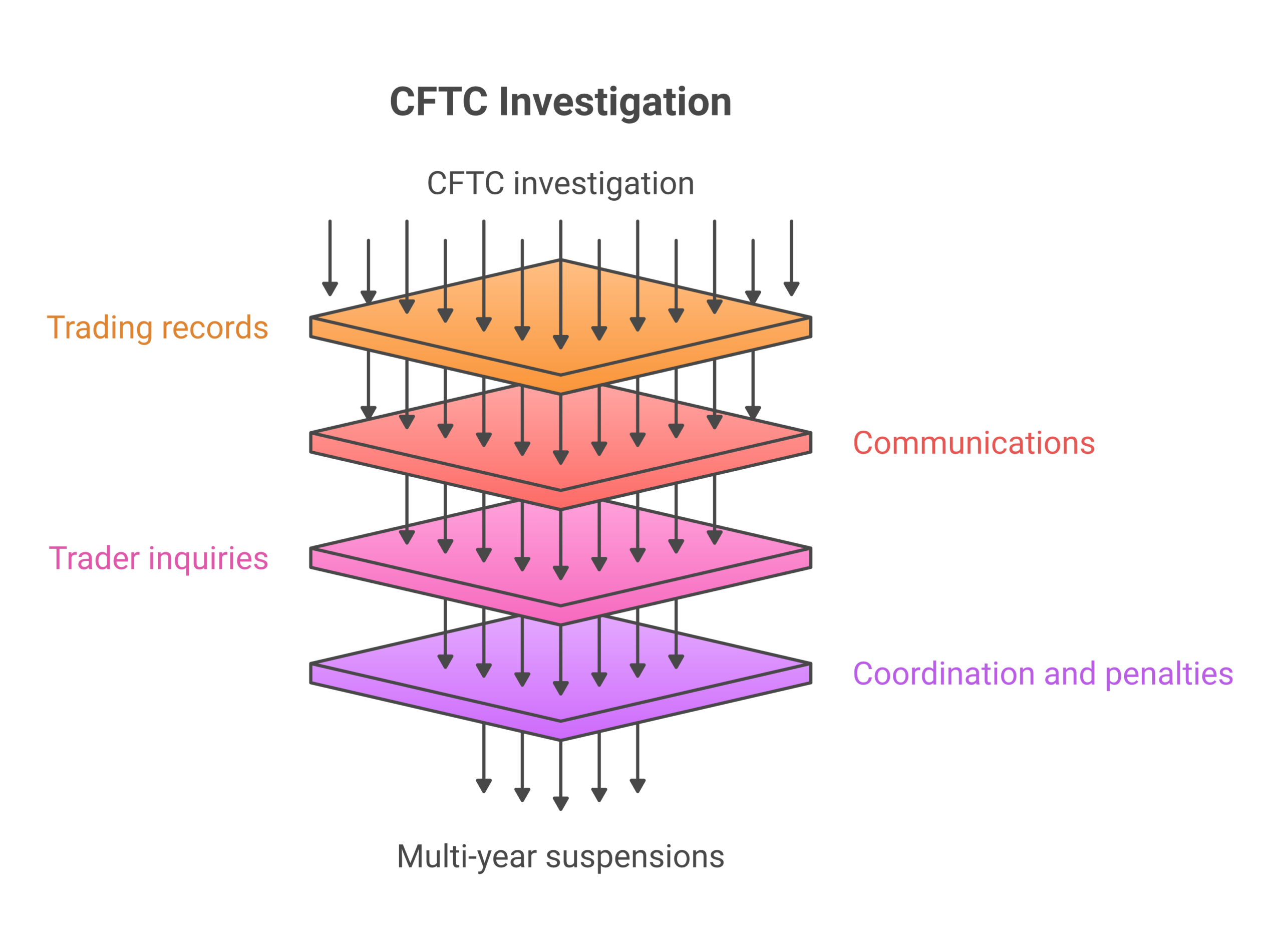
A CFTC investigation typically involves:
- Formal requests or subpoenas for trading records, account data, order history, and position information.
- Demands for communications, including emails, texts, and messages on encrypted platforms.
- Inquiries about a trader’s access to material nonpublic information or ability to influence the outcome of an event.
- Coordination with self-regulatory organizations and platform operators. In recent 2025 matters, the platform Kalshi imposed penalties of $2,246.36 and $20,397.58 along with multi-year suspensions against individual traders. See https://kalshi-public-docs.s3.amazonaws.com/regulatory/notices/Notice%20of%20Disciplinary%20Action%20(2.25.2026)%20(2).pdf
CFTC investigations can result in civil complaints, consent orders, injunctions, disgorgement, and civil monetary penalties. But a civil investigation is not necessarily the end of the matter.
When a CFTC Matter Becomes a Criminal Case
A CFTC civil complaint does not establish criminal guilt. However, the conduct alleged in a CFTC enforcement action can also form the basis of a federal criminal case. The Commodity Exchange Act’s criminal provision, 7 U.S.C. § 13, provides felony penalties for manipulation and knowing violations. Federal prosecutors may also consider charges under other statutes, including wire fraud (18 U.S.C. § 1343), depending on the alleged conduct.
The CFTC and the Department of Justice frequently conduct parallel investigations. The CFTC may refer a matter to the DOJ or coordinate with federal prosecutors from the outset. When the government alleges that a trader used classified or sensitive nonpublic information to profit from event contracts, as alleged in the Van Dyke complaint (Civil Action No. 26-cv-3369, S.D.N.Y.), the facts may implicate both CFTC civil authority and separate federal criminal statutes.
Whether a civil investigation escalates to criminal prosecution depends on the specific facts, the nature and strength of the evidence, the degree of intent the government can demonstrate, and the priorities of the relevant U.S. Attorney’s Office. A person or entity that treats a CFTC investigation as purely a civil matter, without evaluating parallel criminal exposure, takes a serious risk.
Evergreen Attorneys won 9-0 in the U.S. Supreme Court in United States v. Hemani in June 2026.
What to Do if You Face a Prediction-Market Investigation
If you learn that the CFTC, the DOJ, or a trading platform is investigating your prediction-market activity, take these steps:
- Retain experienced federal defense counsel immediately. Do not wait for formal charges or a civil complaint. A federal white-collar defense attorney can evaluate the scope and nature of the investigation, including whether parallel criminal exposure exists.
- Preserve all potentially relevant evidence. Do not delete, alter, move, or conceal trading records, messages, devices, account data, login history, or any other material that may be relevant. Destruction of evidence in the face of a federal investigation is itself a serious federal offense.
- Stop all informal communications with investigators, the platform, and third parties about the matter. Do not provide explanations, narratives, or records to CFTC staff, FBI agents, platform compliance teams, or anyone else until your attorney has evaluated the request. Voluntary statements made without counsel can be used in both civil and criminal proceedings.
- Identify and preserve the exact communications, deadlines, and documents involved. If you have received a subpoena, a civil investigative demand, a federal target letter, or an informal request, provide a copy to your attorney before responding.
- Evaluate privilege and Fifth Amendment considerations. Responding to a CFTC subpoena or platform inquiry without evaluating whether the same information could be used in a parallel criminal case can waive critical protections. Counsel experienced in responding to a Department of Justice subpoena can coordinate a response that protects applicable privileges.
- Assess the full scope of potential exposure. The conduct at issue may implicate federal fraud crimes beyond the Commodity Exchange Act, including wire fraud, conspiracy, or mishandling of classified information. Your attorney should map the complete range of statutes and agencies that may be involved.
How Evergreen Attorneys Can Help
Evergreen Attorneys represents traders, platform operators, and professionals facing CFTC investigations, DOJ scrutiny, and federal criminal exposure arising from prediction-market activity. The firm’s work in this area includes evaluating whether a civil investigation presents parallel criminal risk, coordinating responses to CFTC subpoenas and investigative demands, preserving applicable privileges, and defending against federal grand jury subpoena proceedings that may follow a CFTC referral.
Zachary Newland, the firm’s Founding Partner, has appeared as counsel of record in more than 120 federal cases since 2016. Evergreen Attorneys provides only partner-level representation, ensuring that every client facing a high-stakes federal investigation receives direct attention from an experienced federal criminal defense attorney.
Frequently Asked Questions
What are prediction markets?
Prediction markets are marketplaces where participants buy and sell contracts tied to the outcome of future events. The CFTC explains that these products are commonly called event contracts and are typically structured as swaps with yes-or-no outcomes, fixed payouts, and expiration tied to a specified event or date. The legal characterization of a particular contract depends on its structure and governing law.
What does the CFTC investigate in prediction markets?
The CFTC may investigate alleged fraud, manipulation, misuse of material nonpublic information, conflicts of interest, false statements, wash trading, and other violations involving covered event contracts. Section 6(c)(1) of the Commodity Exchange Act and CFTC Regulation 180.1 prohibit manipulative or deceptive conduct in covered transactions. A CFTC investigation may involve requests for trading records, communications, account information, and explanations of a trader’s access to information or influence over an event.
Can prediction-market trading lead to federal criminal charges?
Yes, in appropriate circumstances, although a CFTC investigation or civil complaint does not itself establish criminal guilt. The Commodity Exchange Act includes criminal provisions, including 7 U.S.C. § 13, which provides felony penalties for specified manipulation and knowing violations. Prosecutors may also consider other federal offenses based on the alleged conduct. Whether criminal charges result depends on the facts, intent, evidence, jurisdiction, and coordination between the CFTC and the Department of Justice.
When should a person or business involve federal defense counsel in a prediction-market matter?
Retain federal defense counsel as soon as you become aware of any federal investigation, platform inquiry, subpoena, target letter, or informal contact from a government agent related to your prediction-market trading or operations. Early involvement of counsel is critical because the same facts that support a CFTC civil action can also support criminal prosecution. Waiting until formal charges are filed limits your attorney’s ability to protect privileges, shape the response to investigative demands, and evaluate whether parallel criminal exposure exists.
If you are facing a federal investigation or CFTC enforcement action related to prediction markets, contact Evergreen Attorneys at (303) 948-1489 for a confidential consultation.

Zachary Newland
Zachary Newland is an attorney, author, aspiring BBQ connoisseur, and enthusiastic, but mediocre skier. Zachary's law practice is focused on federal criminal defense, federal appellate advocacy including post-conviction remedies, civil rights litigation, and complex trial work. Zachary lives in Evergreen, Colorado with his family. Reach out today
STAY IN THE LOOP