Share
Share
Written by Zachary Newland, Founding Partner. Last updated November 18, 2026.
Plea Agreements in Federal Court: The Basics
On This Page
- Why Plea Agreements Matter in Federal Cases
- What Is a Federal Plea Agreement?
- The Three Types of Federal Plea Agreements Under Rule 11(c)(1)
- What the Court Must Do Before Accepting a Guilty Plea
- What Happens When a Judge Rejects a Federal Plea Agreement
- Withdrawing a Federal Guilty Plea
- Appeal Waivers in Federal Plea Agreements
- Steps to Take Before Entering a Federal Guilty Plea
- How Evergreen Attorneys Can Help With Federal Plea Agreements
- Frequently Asked Questions
Why Plea Agreements Matter in Federal Cases
Most federal criminal cases resolve through plea agreements, not trials. In fact, according to the Pew Research Center, over 90% of all federal criminal cases result in guilty pleas with just 2% going to trial (the other 8% resulted in dismissals or non-prosecution).
The terms of a plea agreement determine the charges on a defendant’s record, the sentencing range the court will consider, the amount of restitution the defendant must pay, whether assets will be forfeited, and whether the defendant retains the right to appeal. Getting these terms wrong, or failing to understand what an agreement does and does not guarantee, can produce consequences that last decades.
If you are facing federal charges or have been presented with a proposed plea agreement, the single most consequential decision you will make is whether, when, and on what terms to enter a guilty plea. This article explains how Federal Rule of Criminal Procedure 11 structures plea agreements, what each type of agreement means for your sentencing exposure, and what you should evaluate before accepting or rejecting a government offer.
What Is a Federal Plea Agreement?
A federal plea agreement is a written arrangement between the government and the defense in which the defendant agrees to plead guilty (or nolo contendere) in exchange for specified prosecutorial concessions or sentencing positions.
Federal Rule of Criminal Procedure 11(c)(1) authorizes three categories of concessions the government may offer. The Department of Justice Manual guidance on pleas and plea agreements further instructs federal prosecutors on the policies that govern how agreements should be constructed, what waivers may be included, and how the agreement should reflect the seriousness of the defendant’s conduct.
A plea agreement is not a private contract that takes effect the moment both parties sign it. The court must conduct a formal colloquy under Rule 11, determine that the plea is knowing and voluntary, and either accept, reject, or defer a decision on the agreement. Until the court acts, the agreement’s sentencing terms are not operative. However, courts commonly use contract rules to interpret plea agreements and resolve disputes about their meaning.
The Three Types of Federal Plea Agreements Under Rule 11(c)(1)
Understanding the three categories of plea agreements under Rule 11 is essential because each one carries a different level of certainty about the ultimate sentence.
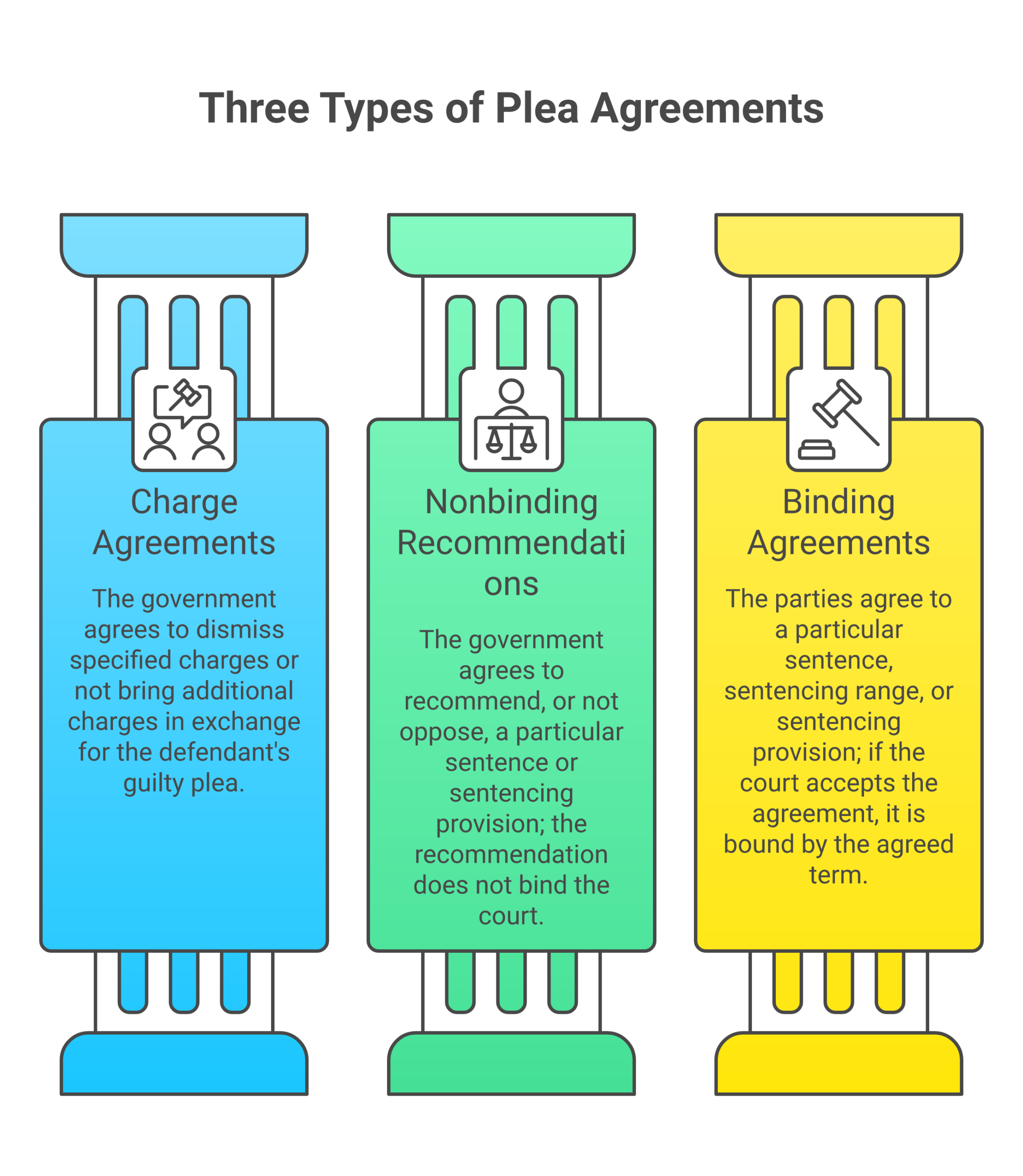
Types of federal plea agreements
Rule 11(c)(1)(A): Charge Agreements
In a charge agreement, the government agrees to dismiss specified charges or not bring additional charges in exchange for the defendant’s guilty plea. The defendant pleads to one or more counts, and the government drops or foregoes others. This directly affects the statutory maximum (and sometimes the statutory minimum) the court may impose but does not bind the court to any particular sentence within the remaining range.
Loss amounts, relevant conduct, and guideline calculations can still produce a sentencing range that surprises a defendant who focused only on which counts were dismissed.
Rule 11(c)(1)(B): Non-binding Sentencing Recommendations
Under a Rule 11(c)(1)(B) agreement, the government agrees to recommend, or not oppose, a particular sentence or sentencing provision. The critical word is “recommend.” The court must advise the defendant that the recommendation does not bind the court and that the court may impose a sentence different from the one recommended.
If the court imposes a harsher sentence than the recommendation, the defendant has no right to withdraw the plea on that basis alone. This is the most common type of plea agreement in federal practice, and it is also the most frequently misunderstood. Many defendants hear “the government will recommend X months” and assume the court will follow that recommendation. The court is not required to do so under these 11(c)(1)(B) agreements.
Rule 11(c)(1)(C): Binding Plea Agreements
A Rule 11(c)(1)(C) binding agreement specifies a particular sentence, sentencing range, or sentencing provision that the parties agree is the appropriate disposition. If the court accepts the agreement, it is bound by the agreed term. If the court rejects the agreement, the defendant must be given an opportunity to withdraw the plea.
A binding plea agreement provides more sentencing certainty than a non-binding recommendation, but courts are not required to accept them. The court must independently determine whether the agreed disposition is consistent with the factors under 18 U.S.C. § 3553(a) and the U.S. Sentencing Guidelines before acceptance. The U.S. Sentencing Commission’s 2026 Guidelines Manual, Chapter 6, requires courts evaluating certain agreements to consider whether the remaining charges adequately reflect the seriousness of the offense.
These binding plea agreements are the gold standard in federal criminal defense. We often hear prosecutors claim that “we don’t do” those kinds of plea agreements or otherwise try to say a policy forbids using them. This is almost universally nonsense. Your first negotiation tactic in any plea situation should be to ask for a binding plea agreement. Period.
Evergreen Attorneys won 9-0 in the U.S. Supreme Court in United States v. Hemani in June 2026.
What the Court Must Do Before Accepting a Guilty Plea
Before the court can accept a guilty plea, Federal Rule of Criminal Procedure 11(b) requires a detailed colloquy on the record. The court must address the defendant personally and determine that the defendant understands the nature of the charges, the rights being waived (including the right to trial, the right to confront witnesses, and the privilege against self-incrimination), the applicable mandatory minimum and maximum penalties, the court’s obligation to consider the Sentencing Guidelines, and the terms of any appeal or collateral-attack waiver.
The court must also confirm that the plea is voluntary and not the result of force, threats, or promises outside the written agreement. The government must state the factual basis for the plea on the record, and the court must find that the facts support each element of the offense. Errors in this colloquy can become grounds for a later motion to withdraw the plea or a challenge on appeal.
This acceptance of the guilty plea may happen either at an earlier hearing or at the beginning of the sentencing hearing itself. Some judges will hold the guilty plea essentially in abeyance while the PSR is prepared and then decide whether or not to reject it at the day of sentencing.
What Happens When a Judge Rejects a Federal Plea Agreement
The consequences of judicial rejection depend on the type of agreement. For a binding Rule 11(c)(1)(C) agreement, the court must give the defendant the opportunity to withdraw the plea if the court rejects the agreed sentence. For a non-binding Rule 11(c)(1)(B) recommendation, the court advises the defendant that it may deviate from the recommendation, and the defendant is given an opportunity to withdraw before the court imposes a different sentence. For a charge agreement under Rule 11(c)(1)(A), rejection is less common because the court’s role is limited to accepting or rejecting the plea itself, not the specific sentencing outcome.
In practice, some judges defer ruling on a plea agreement until after reviewing the presentence investigation report. This means a defendant may plead guilty and then learn weeks later that the court is inclined to reject the agreement or impose a sentence above the recommendation. Understanding this timeline is critical before entering a plea.
Withdrawing a Federal Guilty Plea
A defendant may withdraw a guilty plea before the court accepts it for any reason or no reason. After the court accepts the plea but before sentencing, withdrawal requires a showing of a “fair and just reason” under Rule 11(d)(2)(B).
The Supreme Court addressed the standards for withdrawal in United States v. Hyde, confirming that acceptance of a plea does not automatically entitle the defendant to withdraw it simply because the government has not yet performed its obligations. We will have a longer article on withdrawing a federal guilty plea in the future.
But, once the guilty plea is accepted by the court it is incredibly difficult to withdraw from the guilty plea even before sentencing.
Courts evaluating withdrawal motions consider factors including whether the defendant asserts actual innocence, whether there were deficiencies in the Rule 11 colloquy, the time between the plea and the motion to withdraw, and whether the government would be prejudiced. After sentencing, Rule 11(e) generally bars withdrawal. At that point, the defendant’s options are limited to federal appeals or collateral relief under 28 U.S.C. § 2255.
Appeal Waivers in Federal Plea Agreements
Nearly every federal plea agreement includes a waiver of the right to appeal and, frequently, a waiver of the right to file a collateral attack under 28 U.S.C. § 2255. These waivers are routinely enforced by federal appellate courts and can foreclose challenges to the sentence, the guideline calculations, and even certain constitutional claims.
The Supreme Court’s decision in Hunter v. United States, decided June 18, 2026, clarified an important limit. The Court held that a sentencing appeal waiver is unenforceable when enforcement would result in a “miscarriage of justice,” defined as an obvious, egregious sentencing error that would bring the judicial system into disrepute. This does not render all appeal waivers unenforceable. It establishes a narrow safety valve for the most serious sentencing errors.
Defendants should evaluate appeal waivers with particular care in cases involving disputed loss amounts, contested relevant conduct, or unresolved issues such as federal grand jury subpoena responses that could affect the factual basis of the plea.
Steps to Take Before Entering a Federal Guilty Plea
- Read the entire written plea agreement, including all attachments, addenda, and sentencing stipulations.
- Identify every charge the government will dismiss or decline to bring.
- Determine whether the agreement is a charge agreement under Rule 11(c)(1)(A), a nonbinding recommendation under Rule 11(c)(1)(B), or a binding agreement under Rule 11(c)(1)(C).
- Calculate your likely Sentencing Guidelines range, including offense level, criminal history category, relevant conduct, loss amounts, and any applicable enhancements or reductions.
- Identify every mandatory minimum sentence that applies to the remaining charges and determine whether a safety-valve exception exists.
- Review all restitution, forfeiture, and special assessment provisions.
- Read the appeal waiver and collateral-attack waiver carefully. Identify what claims survive and what claims are waived.
- Compare the government’s oral representations and any informal promises with the written agreement. If they conflict, the written agreement controls.
- Ask your attorney to explain what happens if the judge rejects the agreement, particularly for a binding Rule 11(c)(1)(C) plea.
- Do not enter a guilty plea until you have resolved every open question with your defense counsel.
How Evergreen Attorneys Can Help With Federal Plea Agreements
Evergreen Attorneys represents individuals and businesses facing federal criminal charges at every stage, from investigation through federal plea negotiations and sentencing. The firm’s practice focuses exclusively on federal criminal defense, including federal fraud crimes defense, drug offenses, and other high-stakes matters that frequently resolve through negotiated pleas.
Zachary Newland, Founding Partner, has appeared as counsel of record in more than 130 federal cases since 2016. His experience spans plea negotiations across multiple federal districts, guideline calculations, binding and non-binding agreement structures, and contested sentencing proceedings.
The firm evaluates proposed plea agreements against the full range of sentencing exposure, including loss amounts, relevant conduct, mandatory minimums, restitution, and forfeiture, so that a client’s decision to plead guilty is based on a clear understanding of the likely outcome.
For defendants who have already entered a guilty plea and face sentencing concerns or believe a Rule 11 error occurred, Evergreen Attorneys also handles white collar criminal appeals and post-conviction remedies, including challenges to sentences imposed after a plea and motions to withdraw a guilty plea before sentencing.
Frequently Asked Questions
What is the difference between a binding and a nonbinding federal plea agreement?
A non-binding agreement under Rule 11(c)(1)(B) allows the government to recommend a sentence, but the court is free to impose any lawful sentence, including one higher than the recommendation. The defendant generally cannot withdraw the plea simply because the court departed from the recommendation. A binding agreement under Rule 11(c)(1)(C) specifies an agreed disposition that the court must follow if it accepts the agreement. If the court rejects a binding agreement, the defendant has the right to withdraw the plea. The distinction determines how much sentencing certainty the plea provides.
Can a federal guilty plea be withdrawn after it is accepted?
Before sentencing, a defendant may withdraw an accepted guilty plea only by showing a fair and just reason under Rule 11(d)(2)(B). The Supreme Court confirmed this standard in United States v. Hyde. Courts evaluate factors including assertions of innocence, deficiencies in the Rule 11 colloquy, and the time elapsed since the plea. After sentencing, Rule 11(e) generally bars withdrawal, and the defendant’s remedies are limited to direct appeal or collateral relief. Any withdrawal attempt should be raised promptly because delay weakens the showing.
How does the Hunter v. United States decision affect appeal waivers in plea agreements?
The Supreme Court held in Hunter v. United States, decided June 18, 2026, that a sentencing appeal waiver is unenforceable when enforcement would result in a miscarriage of justice. The Court defined that standard as an obvious, egregious sentencing error that would bring the judicial system into disrepute. This does not eliminate appeal waivers. It establishes a narrow safety valve for cases involving plain and serious sentencing errors.
A defendant considering whether to sign a waiver should evaluate the anticipated guideline range, any mandatory minimum exposure, and whether unresolved issues such as PPP loan fraud defense loss calculations or restitution amounts could produce an erroneous sentence.
When should a person facing federal charges involve defense counsel in evaluating a plea agreement?
Defense counsel should be involved before the first substantive discussion with the government about a possible plea. The terms of a plea agreement, including charge selection, factual stipulations, guideline calculations, and waiver provisions, are shaped by negotiation. Once an agreement is finalized and presented to the court, changing terms becomes far more difficult. If you have already received a proposed agreement, have defense counsel review it before you sign. If you have already entered a guilty plea and believe the agreement was not what you expected, raise the issue with counsel immediately. The window to withdraw a plea or preserve a sentencing objection closes quickly.
If you are facing federal criminal charges or have been presented with a proposed plea agreement, contact Evergreen Attorneys at (303) 948-1489 for a confidential case evaluation today.

Zachary Newland
Zachary Newland is an attorney, author, aspiring BBQ connoisseur, and enthusiastic, but mediocre skier. Zachary's law practice is focused on federal criminal defense, federal appellate advocacy including post-conviction remedies, civil rights litigation, and complex trial work. Zachary lives in Evergreen, Colorado with his family. Reach out today
STAY IN THE LOOP