Share
Share

Written by Zachary Newland, Founding Partner. Last updated August 11, 2026
What Is a Federal Target Letter and What Should You Do Next
On This Page
- What a Federal Target Letter Means for You
- How a Federal Target Letter Works
- The Federal Grand Jury Investigation Process Behind a Target Letter
- What to Do After Receiving a Federal Target Letter
- How Evergreen Attorneys Can Help With a Federal Target Letter
- Frequently Asked Questions
If you have received a federal target letter, the United States Attorney’s Office has identified you as a person the government believes committed a federal crime. This is not a routine inquiry. It means a federal grand jury is actively investigating you, and prosecutors have enough evidence to consider seeking an indictment. What you do in the days immediately following receipt of this letter can shape the trajectory of your case, your exposure to criminal charges, and your ability to mount an effective defense.
If federal agents have contacted you or you have received a federal document, contact Evergreen Attorneys at (303) 948-1489 before responding or producing information. Evergreen Attorneys is Colorado’s U.S. Supreme Court winning federal criminal defense boutique.
What a Federal Target Letter Means for You
A federal target letter is a written notification from a federal prosecutor informing the recipient that they are a “target” of a federal grand jury investigation. According to DOJ Manual Section 9-11.151, a target is a person as to whom the prosecutor or the grand jury has substantial evidence linking them to the commission of a crime and who, in the judgment of the prosecutor, is a putative defendant. The DOJ’s DOJ sample target letter advises the recipient of their target status and of their constitutional right to refuse to answer questions that could tend to incriminate them.
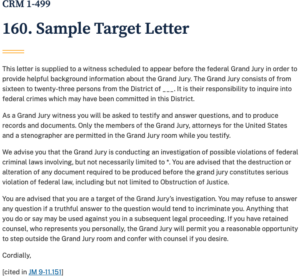
A target letter is not an indictment, a warrant, or a conviction. It is the government’s way of putting you on formal notice that criminal charges are being considered. However, the distinction between a target letter and an indictment is critical: at this stage, the investigation is ongoing, and no formal charges have been filed. That window of time between the letter and a potential indictment is one of the most consequential periods in any federal criminal case.
How a Federal Target Letter Works
The federal government classifies individuals involved in grand jury investigations into three categories: targets, subjects, and witnesses. A target sits at the highest level of scrutiny. The prosecutor has already gathered what the office considers substantial evidence of criminal conduct.
Target letters typically arise in federal white collar defense matters, including wire fraud, healthcare fraud, PPP loan fraud defense, tax fraud, and conspiracy under 18 U.S.C. § 371. They also appear in federal drug investigations and other complex multi-defendant cases.
The letter usually contains several key elements:
- Identification of the recipient as a target of a grand jury investigation
- A statement of the recipient’s Fifth Amendment right against self-incrimination
- An invitation to appear before the grand jury (voluntary, not compulsory)
- Contact information for the assigned Assistant United States Attorney
- A reference to the federal district where the grand jury is sitting
The letter does not typically specify the charges being considered in detail. It tells you that the government views you as a likely defendant, not as a peripheral witness.
It is important to remember that receiving a target letter is a key inflection point in DOJ investigations. You received the target letter because either the grand jury or the federal prosecutor want to speak with you. This is often the last “best chance” that you will have to try to avoid criminal charges altogether.
The Federal Grand Jury Investigation Process Behind a Target Letter
Federal grand juries operate in secret under Federal Rule of Criminal Procedure 6(e). The grand jury hears evidence presented by the prosecutor, including testimony from witnesses, documentary evidence, and records obtained through subpoenas. Grand jury proceedings are one-sided: there is no judge presiding over the evidence, no cross-examination, and no defense presentation. The grand jury alone decides whether probable cause exists to return an indictment.
When you receive a target letter, the grand jury has likely already been reviewing evidence related to your conduct. This is not guaranteed however as a target letter may issue before grand jury proceedings begin. It truly varies from office to office on how and when target letters are sent out.
The government may have issued a federal grand jury subpoena to banks, employers, business partners, or other third parties. Agents may have already conducted interviews with witnesses or co-conspirators.
The letter may invite you to testify before the grand jury. This is rarely advisable without experienced federal criminal defense counsel. Anything you say before a grand jury is under oath and can be used against you in a subsequent prosecution. False statements before a grand jury can create additional criminal exposure.
Most importantly, once you speak under oath you have waived your otherwise applicable Fifth Amendment right to remain silent.
Evergreen Attorneys wins 9-0 in the U.S. Supreme Court.
What to Do After Receiving a Federal Target Letter
The period after receiving a target letter demands deliberate, informed action. The following steps reflect the priorities that matter most in protecting your position before a potential indictment.
- Stop and read the letter carefully. Identify the federal district, the AUSA’s name, and any deadlines or requests. Do not call the prosecutor or respond in writing.
- Retain experienced federal defense counsel immediately. A target letter triggers the need for a lawyer who understands federal grand jury procedure, pre-indictment strategy, and the specific area of federal law at issue. General criminal defense experience is not sufficient for this stage.
- Preserve all documents and electronic records. Once you are on notice of a federal investigation, destroying, altering, or concealing documents can expose you to obstruction of justice charges under 18 U.S.C. § 1503 and related statutes. This applies to emails, texts, financial records, and any other material that could be relevant to the investigation.
- Do not discuss the investigation with potential co-targets, business partners, or witnesses. These conversations can be characterized as efforts to coordinate testimony or obstruct the investigation.
- Evaluate the scope of the investigation with counsel. Your attorney can contact the AUSA to learn more about the nature of the investigation, assess the government’s posture, and determine whether pre-indictment negotiations, cooperation discussions, or a proffer session are strategically appropriate.
- Decide whether to appear before the grand jury. In most federal target letter defense situations, targets exercise their Fifth Amendment right to decline grand jury testimony. This decision should be made with counsel after a full assessment of the facts and the government’s case.
How Evergreen Attorneys Can Help With a Federal Target Letter
Evergreen Attorneys handles DOJ investigations and federal criminal defense matters, including target letters, pre-indictment grand jury investigations, and white collar criminal defense. Founding Partner Zachary Newland has appeared as counsel of record in more than 120 federal cases since 2016 and concentrates on the critical pre-charge phase where defense strategy has the greatest impact on outcomes.
The firm’s work on target letter matters involves assessing the scope of the federal investigation, analyzing the government’s evidence posture, advising on document preservation obligations, evaluating the risks and potential benefits of pre-indictment engagement with the prosecutor, and preparing a defense strategy that accounts for the possibility of indictment, cooperation, or resolution.
This is substantive federal defense work that begins before charges are filed and is aimed at protecting the client’s legal position at every stage. Put bluntly, your goal when receiving a target letter is either 1) convince the government not to file charges or 2) prepare the absolute strongest trial defense if charges are unavoidable.
Evergreen Attorneys is here to help with discretion gained over decades of practice.
Frequently Asked Questions
Is a target letter the same as an indictment?
No. A target letter is a pre-indictment notification that the government considers you a likely defendant in a federal grand jury investigation. An indictment is a formal charging document returned by the grand jury after it finds probable cause.
Receiving a target letter means the investigation is active and serious, but no charges have been filed. The time between the target letter and a potential indictment is a critical window for defense preparation. In white-collar cases, it is often the single most important time to convince the government that charges would be improper.
Can I ignore a federal target letter?
Ignoring the letter does not stop the investigation or prevent an indictment. The grand jury will continue its work with or without your participation. More importantly, conduct after receipt of a target letter can create additional criminal exposure. Destroying documents or electronic records after you are aware of the investigation can lead to obstruction charges under U.S. Code official statutes such as 18 U.S.C. § 1503. The letter should be treated as a serious legal warning.
Does receiving a target letter mean I am guilty?
No. A target letter reflects the prosecutor’s current assessment that substantial evidence links you to possible criminal conduct. It is an investigative step, not a determination of guilt.
The government may still seek additional evidence, negotiate, or ultimately decide not to prosecute. However, the letter signals that the risk of indictment is real and that immediate legal guidance is necessary. This is not the time to delay.
When should a person or business involve federal defense counsel after receiving a target letter?
Federal defense counsel should be retained immediately, before you respond to the letter, contact the prosecutor, speak with potential co-targets, or make any decisions about document handling. The pre-indictment phase is where strategic decisions about cooperation, grand jury testimony, and evidence preservation have the greatest consequences. Delaying counsel allows the government to advance its case while you operate without a clear defense strategy.
If you are facing a federal target letter or a federal grand jury investigation, contact Evergreen Attorneys at (303) 948-1489 for a free and confidential case evaluation with a federal criminal defense attorney.

Zachary Newland
Zachary Newland is an attorney, author, aspiring BBQ connoisseur, and enthusiastic, but mediocre skier. Zachary's law practice is focused on federal criminal defense, federal appellate advocacy including post-conviction remedies, civil rights litigation, and complex trial work. Zachary lives in Evergreen, Colorado with his family. Reach out today
STAY IN THE LOOP
Subscribe to our free newsletter.

Written by David Boyer, Partner. [...]