Share
Share
Federal Sentencing Lawyers
A conviction for a federal offense is not the end of the road. Often times the fight has only just begun. The federal sentencing lawyers at Evergreen Attorneys are ready to provide a plan and hope for sentencing in federal courts. If you are or a loved one are facing the uncertainty of sentencing in a federal case, you deserve the best team of federal sentencing lawyers at your side.
What Makes Evergreen Attorneys Different?
We only handle federal cases.
There are dozens if not hundreds of lawyers you can find on the internet who claim to be experienced federal criminal defense lawyers. Almost all of these Denver wire fraud lawyers claim to be “experts” or “fighters” who will give you “aggressive representation” or something similar.
Here are some of the things that we think makes Evergreen Attorneys different from the pack:
- We only practice federal criminal defense. No family law clients, no medical malpractice, no transactional lawyers. All federal work. Every day.
- We only employ experienced partner-level attorneys. No fresh-faced associates right out of law school.
- We are a boutique federal white collar law firm. Every decision is tailored towards providing client-first exceptional criminal defense.
- Evergreen Attorneys handles cases nationwide. We are not interested in being golfing buddies with the prosecutor.
U.S. Sentencing Commission’s Proposed 2026 Guidelines Amendments
The United States Sentencing Commission has proposed new amendments for the 2026 U.S. Sentencing Guidelines. Read more to find out more about the U.S. Sentencing Commission, how the U.S. Sentencing Guidelines are used at sentencing, what changes could be coming in 2026, and how you can voice your opinion on the proposed amendments.
What is the U.S. Sentencing Commission?
The United States Sentencing Commission (U.S.S.C.) is an independent part of the judicial branch tasked by Congress with creating federal sentencing policies, including the U.S. Sentencing Guidelines Manual. The Commission was first created by Congress in 1984 as part of the Sentencing Reform Act.
The U.S.S.C. collects and publishes a broad amount of data related to federal sentencings across the country. They use this information to propose amendments to the Sentencing Guidelines that affect individuals charged with federal crimes.
What are the Sentencing Guidelines?
The United States Sentencing Guidelines (U.S.S.G.) were first established by the Sentencing Reform Act of 1984 in an effort to make more consistent federal sentences nationwide. These Guidelines were initially mandatory (meaning a district judge had to sentence a person within the guidelines range without discretion).
Unfortunately, the creation of mandatory sentencing guidelines had the opposite effect. Federal defendants were forced to serve overly harsh sentences and the mandatory guidelines tied many judges’ hands in determining an appropriate sentence.
The Guidelines remained mandatory (meaning judges had to follow the guidelines no matter what) until the Supreme Court’s decision in United States v. Booker in 2005. After Booker, the U.S. Sentencing Guidelines are no longer mandatory. However, federal courts are still required to correctly calculate a defendant’s guidelines range using the U.S. Sentencing Guidelines Manual, and the majority of people sentenced in federal courts are sentenced within this advisory guideline range.
How do the Sentencing Guidelines Work?
The U.S. Sentencing Guidelines Manual is a dense book that uses a dozens of factors to determine what a federal criminal defendant’s advisory guidelines range should be for sentencing.
It is incredibly important to have a federal sentencing lawyer that has a deep understanding of the Guidelines and the sentencing process. A mere passing knowledge is often not enough to properly fight for a reasonable sentence. Many federal appeals and post-conviction motions are based on federal courts and attorneys’ misunderstanding of the application of the Guidelines.
Understanding the Guidelines takes years and years of practice and experience. For simplicity, we will break down the process into 5 steps.
Step One: Determining the Base Offense Level
The Base Offense Level is set by the U.S. Sentencing Guidelines Manual and depends on the offense and other factors. Some offenses have a specific base offense level that applies across the board. Others, such as drug cases or fraud, depend on other facts that the judge must find by a preponderance of the evidence. For example, in drug cases the base offense level is increased based on the weight of the drugs possessed/distributed/dispensed. In most fraud cases, the base offense level is increased by the amount of money the court finds is lost as a result of the fraud.
Step Two: Specific Offense Characteristics
Specific Offense Characteristics are part of the guidelines that usually increase the offense level based on specific factors present in the case. For example, a wire fraud case may see an increased offense level based on the “use of sophisticated means” or the number of victims.
Step Three: Chapter 3 Adjustments
The base offense level and specific offense characteristics are found in Chapter 2 of the Guidelines and are offense-specific. This means that the offense level and specific offense characteristics for wire fraud (found in U.S.S.G. § 2B1.1) are completely different than conspiracy to distribute a controlled substance (U.S.S.G. § 2D1.1). So an enhancement under § 2B1.1 typically doesn’t apply to a drug crime and vice versa.
Chapter 3 Adjustments are different. These can apply to any offense based on the facts of a case regardless of what the person is charged with. The most typical Chapter 3 adjustments are “leadership” enhancements. Under U.S.S.G. § 3B1.1, a person can receive a 2, 3, or 4-level enhancement if they are found to be a leader, organizer, or supervisor in the offense.
Other common Chapter 3 Adjustments include an abuse of a position of trust or special skill (§ 3B1.3) and obstruction of justice (§ 3C1.1). Why is it important to truly understand how the Guidelines apply? Often times certain offense-specific enhancements mean that similar Chapter 3 adjustments do not apply. However, far too often we see probation officers, lawyers, and judges miss these nuances and the defendant becomes the victim of double counting.
Chapter 3 also includes the process for determining the offense level when there are multiple counts of conviction. This process can become complicated very quickly, and it can also result in massive increases to a defendant’s guidelines range. Again, we cannot stress enough how necessary it is to have a federal sentencing lawyer who knows how these adjustments apply to protect your rights and ensure a fair sentencing. You cannot count on U.S. Probation, the prosecution, or even the judge to make sure that you receive a fair and just sentence. You need an attorney who knows the law and how it applies in your case to fight for the best outcome for you.
Step Four: Calculating Criminal History
The next step in determining a sentencing range is finding the “criminal history category.” This is found in Chapter 4 of the Guidelines. Prior offenses are assessed “criminal history points” which correspond to the criminal history category. Not all prior offenses qualify for points–you need to make sure your sentencing lawyer knows how to correctly calculate criminal history. A defendant who is placed in the wrong criminal history category can have their guidelines range significantly increased.
Chapter 4 also includes the notorious “career offender” enhancement under U.S.S.G. § 4B1.1. This enhancement raises the offense level and maxes out the criminal history category resulting in the most severe of sentencing ranges.
Step Five: Determine the Guideline Range
Once the total offense level and criminal history category are determined, the court will use Chapter 5’s Sentencing Table to find the advisory guideline range. A copy of the table is below:
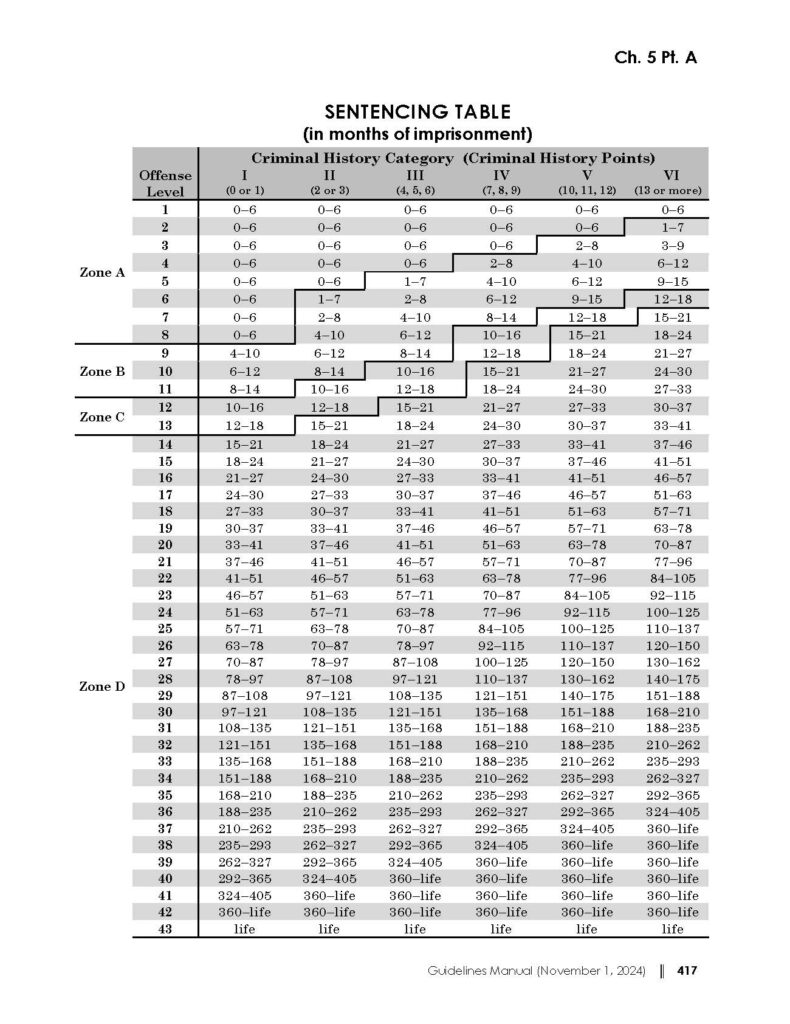 U.S.S.G. Ch. 5 Pt. A (2025)
Guidelines Examples:
- A total offense level of 20 and criminal history category I produces a Guideline range of 33 to 41 months imprisonment.
- A total offense level of 20 and criminal history category IV produces a Guideline range of 51 to 63 months
- A total offense level of 43 and any criminal history category calls for a life sentence.
The Amendment Process
Each June the Sentencing Commission proposes its next year’s priorities. The commission will use those priorities to make a number of changes and amendments to the Sentencing Guidelines.
The Sentencing Commission will announce its proposed amendments and offer an opportunity for public comment. Public comment can come from anyone–individuals, organizations, lawyers, judges, anyone that has an opinion on the proposed changes.
Following public comment, the Commission will publish its final list of amendments in May the following year. If Congress does not block the amendments (which it usually doesn’t) then the amendments go into effect on November 1st.
Some amendments are simply technical and don’t really change anything of substance. Other times these amendments can be substantial. In 2014, Amendment 782 reduced the offense level for certain drug quantities and was made retroactive. This resulted in thousands of federal defendants receiving a reduction after they were sentenced. Other substantive amendments may not be retroactive but can benefit individuals who have not yet been sentenced.
Proposed Amendments for 2026
Drug Offenses
Part A of this amendment addresses the disparity between offenses involving methamphetamine and methamphetamine (actual) [having a higher purity]. Currently, methamphetamine (actual) is punished 10 times harsher than a mixture or substance containing methamphetamine. This part of the proposed amendment has two options: eliminating the disparity completely or reducing the ratio or amending the ratio to match cocaine and cocaine base.
Part B of this amendment will create harsher penalties for individuals convicted of drug offenses involving fentanyl.
Inflationary Adjustment and Changes to Economic Loss Table
The economic loss table under U.S.S.G. § 2B1.1 is used to determine the offense level for most fraud and property loss offenses. This table was revised in 2015 to account for increased economic inflation in Amendment 791. This 2026 amendment would increase the dollar value threshold for each offense level under the economic loss table as shown below:
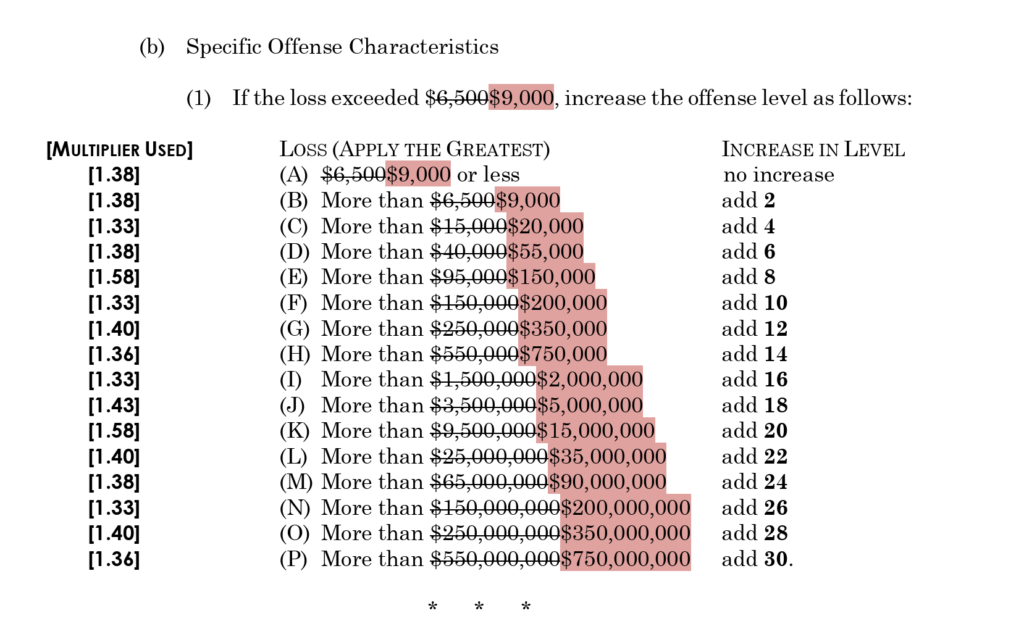
In addition to adjusting for inflation in Proposed Amendment No. 2, this amendment seeks to simplify and restructure the loss table in § 2B1.1 as shown below:
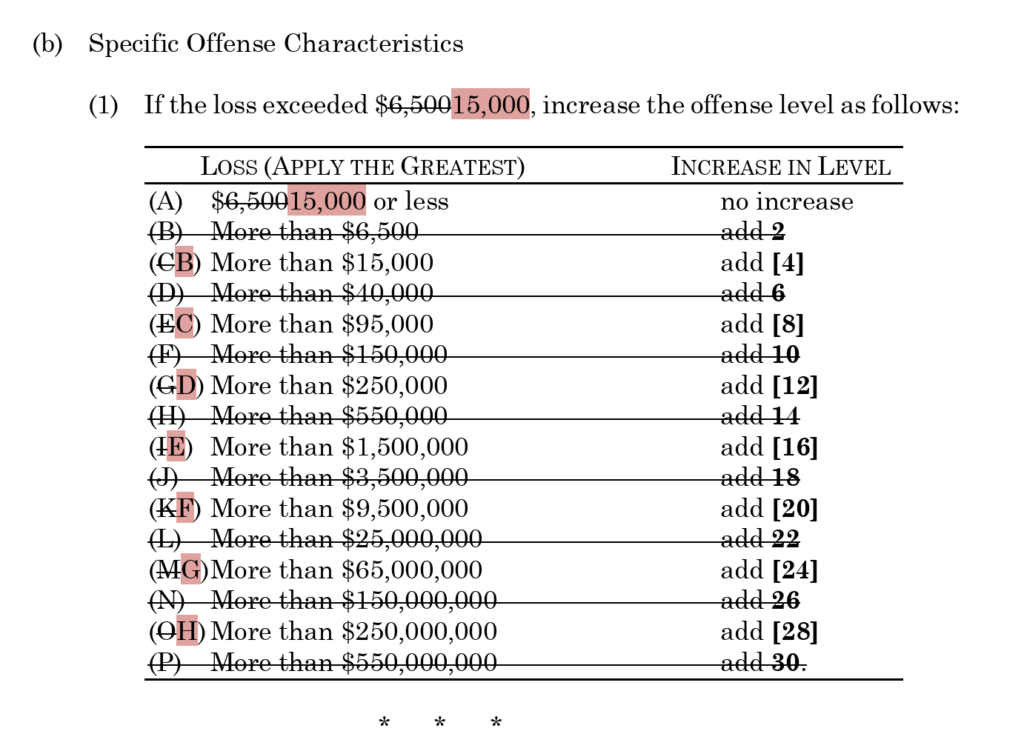
The 2015 Amendment 791 was not retroactive, meaning anyone sentenced prior to the amendment could not benefit from the change. We do not yet know if this amendment will pass and, if it does, if it will be made retroactively available to people already serving a sentence. This is part of why public comment is important. The Sentencing Commission wants to hear from people who want this amendment to pass and be applied retroactively to individuals currently in prison.
Post-Offense Rehabilitation Adjustment
This amendment would create a new guideline section, U.S.S.G. § 3E1.2, which would provide for a reduction in the offense level based on post-offense rehabilitation efforts or behavior. The amendment could allow for a 1, 2, 3, or 4-level reduction based on a defendant demonstrating rehabilitative efforts or behavior before sentencing.
Other Proposed Amendments
The Commission has proposed several other amendments that are technical or too complex for this brief synopsis. These proposed amendments include: changes to grouping for multiple counts of conviction; simplification of certain parts of the Guidelines Manual; changes to the definition of “sophisticated means;” and other miscellaneous changes.
The entire text of the 2026 Proposed Amendments can be found here.
Make Your Voice Heard
Public comment on these proposed amendments is open until February 10, 2026. Anyone is welcome to submit their comments. Why submit a comment? Some of these proposed amendments could have significant impacts, such as a lesser sentence, for federal defendants who have not yet been sentenced. Others, such as the changes to the economic loss table, could be made retroactive by the Sentencing Commission.
The 2015 changes to the economic loss table were not made retroactive–which meant that no one sentenced before the amendment took effect could benefit. This is one of the benefits of public comments: you can tell the Sentencing Commission that these changes should go into effect and should apply to people who have already been sentenced.
There are two ways to submit your comments to the U.S. Sentencing Commission:
(1) Electronic Submissions of Comments – You can submit your comments to the Sentencing Commission electronically by clicking this link and following the online instructions: Public Comment Submission Portal.
(2) Submission by Mail: Alternatively, you can mail your comments to the Sentencing Commission at the following address:
United States Sentencing Commission
One Columbus Circle, N.E.
Suite 2-500
Washington, DC 20002-8002
Attention: Public Affairs – Proposed Amendments
Evergreen Attorneys Federal Sentencing Lawyers
The federal sentencing lawyers at Evergreen Attorneys are on the forefront of the changes being made to the U.S. Sentencing Guidelines, important decisions from courts across the country, and changes in law that can affect an individual’s federal sentence. If you or a loved one are looking for experienced and capable federal sentencing attorneys, do not hesitate to reach out to us for a free consultation. We can be reached at (303) 948-1489 or by email at [email protected].

David Boyer
It was David’s passion for the law and helping others that led him to becoming an attorney. He particularly enjoys appellate and post-conviction work.
David is proud to offer representation nationwide from his office in Plano, Texas.
STAY IN THE LOOP
Subscribe to our free newsletter.
FOR IMMEDIATE RELEASE Kirsten Holder, [...]